
| Menu |
08
Jun
2019
Inboard, outboard or stern drive, diesel or petrol (even electric). 2 - 425hp, all of this is academic to moving your boat on the water without a propeller.
This critical part of boating attracts huge amount of attention, chitchat and quite often misunderstanding.
In this review we will concentrate on the powerboat owner.
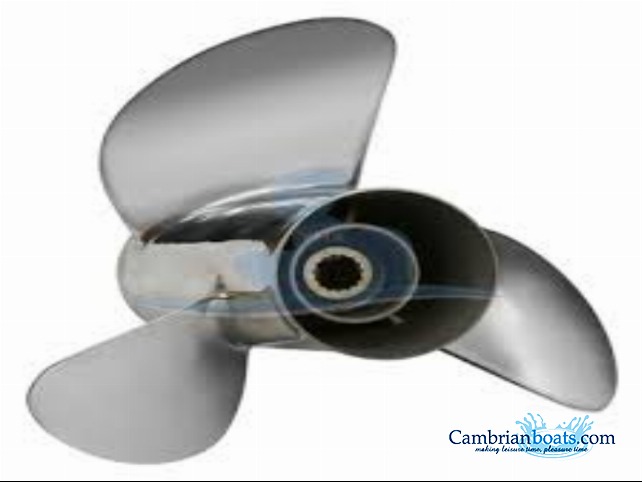
Starting with the basics, a propeller is usually announced by its diameter and pitch, therefore a 14x21 has a diameter of 14 inches and a pitch of 21 inches. But what does this mean?
Well the diameter is the width of the propeller created by one rotation in inches and the pitch is, in the same 360 degree rotation in theory, how far it will travel forward in inches.
Now we get to more complicated issues. Construction - is it plastic, aluminium, bronze or stainless steel? How many blades? What shape? (Yes there are differences). In essence it’s probably best to identify what use the boat will have, the size, weight and hull type and what engine is fitted (some propellers may not be available for types of drive). In the main, most new outboard engines up to 115hp have aluminium props as standard, the very small engines have plastic and large, powerful engines stainless steel. Bronze propellers tend to be favoured on displacement or semi-planing shaft drive outfits.
Let’s go back to the start of the previous paragraph. Why a number of blades? Well in a nutshell fewer blades mean less drag and therefore potentially more speed. However, more blades equal a smoother ride as the gap between each load is less, it also means greater grip, and that’s why waterskiers favour propellers such as a five blade option to give a greater pull from stationary, coming out of the water by virtue of more acceleration.
Those in need of outright speed often use fast-spinning three-bladed props although the former and latter tend to both favour the stainless steel option being more efficient due to it’s stiffness.
Phew - had enough? There’s more yet!
So you know what kind of boating you are likely to undertake, you should be able to have a pretty good idea at picking a prop with a suitable blade number, diameter and pitch. Now the finer points come into play - cupping ( which is the lip on the trailing edge of the blade) and rake (the amount the blade is angled back).
By increased cupping you maximise the grip and acceleration from standstill, while minimising cavitation - and because it can add up to an inch of pitch to a proppeller, it can sometimes be used to transform the performance of over-revving. Increased rake is designed to give more bow lift, this takes more of the hull clear of the water and generating greater top speed on fast planing boats. A word of caution though, while great for economical cruising, excessive rake can make a boat rather flighty at top end.
There are even more scientific factors to observe. However the same propeller can offer very different experiences on what appears to be the same boat. Indeed, the same boat can feel different just by virtue carrying different numbers of passengers, fuel and other weights on board, even where the fuel tank is located has a bearing.
Whichever one is selected, there is always likely to be a compromise. Best advice, where the opportunity exists, is to try different propellers to find the most suitable fit.